
Public API
Published daily options metrics.
The daily-data API serves the same published observations as the data archive: available dates, latest published metrics, individual snapshots and paginated date ranges. Values retain their units, UTC snapshot times, provenance and unavailable reasons.
curl https://api.derivasys.com/api/v1/data/BTC/latestStart with the daily data API documentation linked above for all endpoints, Python and curl examples, pagination, limits and caching. These are published daily observations; use the separate WebSocket evaluation for live surface updates.
Streaming
WebSocket stream.
The streaming API bootstraps consumers with a full surface snapshot, then sends compact patches as quotes, fits, risk metrics, and fixed-tenor rows change. The browser dashboard uses this same contract for live market monitoring.
- svi_surface_snapshot and svi_surface_patch for calibrated surface state.
- smile_levels_snapshot and patch messages for bid, ask, trade, and venue-level quote overlays.
- svi_tenor_snapshot and patches for fixed-tenor term-structure outputs.
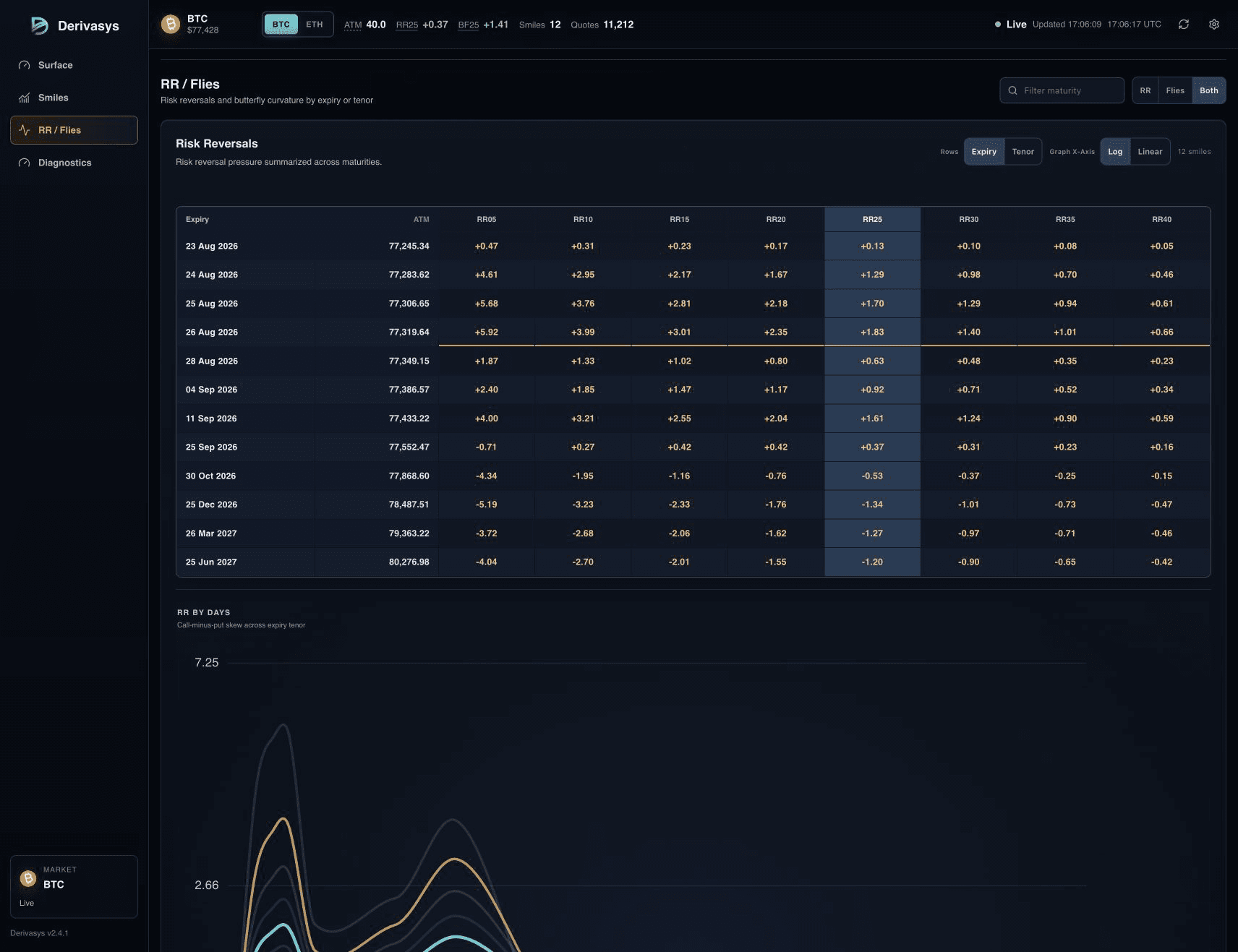
- Fit-status, risk-reversal, fly, and diagnostic messages around each calibration cycle.
Current state
Live-surface REST evaluation status.
Live-surface REST behavior remains in testing, is supplied only under evaluator-specific terms, and is not generally available. Endpoint names, authentication, limits and resource availability can change and are supplied directly to an approved evaluator.
- Current surface and smile state are candidate evaluation resources.
- Fixed-tenor and fit-diagnostic responses remain testing behavior.
- Consumers must use the endpoint names and schema version supplied with their evaluation access.
Payloads
Live WebSocket payload expectations.
Payloads are JSON and include the active currency where available. Consumers should treat snapshots as authoritative bootstrap state and patches as sparse updates.
{
  "type": "svi_surface_snapshot",
  "schemaVersion": 1,
  "ccy": "BTC",
  "smiles": [{
    "expiry": 1778990400000,
    "label": "17MAY26",
    "x_axis": { "kind": "log_moneyness", "values": [-0.3, 0, 0.3] },
    "vol": [42.1, 34.8, 38.6],
    "risk_reversals": { "RR25": -5.57 },
    "flies": { "BF25": 1.37 }
  }]
}
Diagnostics
Dashboard diagnostics exposed through the API.
The same diagnostics shown in the dashboard can be published for testing: through-fit cells, skew and fly term structures, fit error state, active smile count, and fixed-tenor rows.
History
Historical API changes.
Live API evaluation is request based. Public daily-data API documentation is available separately from these live-surface implementation notes.
- October 15, 2026: Published the daily-data REST API with seven-asset discovery, latest observations, dated metrics and paginated date ranges. No API key is required for published daily data.
- May 16, 2026: Added request-based WebSocket and REST API testing documentation, including current-state REST resource families.
- May 16, 2026: Documented fixed-tenor WebSocket outputs through svi_tenor_snapshot and tenor patches, plus evaluator-specific REST testing.
- May 16, 2026: Added multi-currency testing language for BTC, ETH, and additional currencies under review.
- May 16, 2026: Added dashboard consumer support for smile_levels_snapshot_batch messages.
- May 16, 2026: Added dashboard consumer handling for currency-selection messages and outgoing select_currency requests.
- May 16, 2026: Broadened accepted fly and butterfly payload aliases, including fly_values, butterfly_values, bf, and rr_fly.
- May 16, 2026: Broadened accepted fly node payload aliases, including fly_nodes, butterfly_nodes, and camelCase node-point variants.
- May 16, 2026: Restored fly diagnostics when scalar FLYxx values are absent by deriving them from matching put, call, and ATM node vols.
Requesting access
Request live surface access.
The public daily-data API needs no request or account. For live surface evaluation, email info@derivasys.com with the intended use case, currency scope, preferred protocol, and whether fixed-tenor outputs are required. Test access can then be configured with the appropriate endpoint, key, and usage expectations.