
Our own calibrated surfaces
We fit exchange quotes across strikes and expiries into a consistent view of each market.
Crypto options analytics
Derivasys builds live volatility surfaces from exchange quotes. Compare pricing across seven crypto markets, track changes in volatility and skew, and inspect the quality of the underlying data.
Coverage BTC · ETH · SOL · XRP · HYPE · AVAX · TRX
DELAYED · OLDEST DATA 1M AGO · REFRESH UNAVAILABLE · CACHED · AS OF
Why Derivasys
We fit exchange quotes across strikes and expiries into a consistent view of each market.
Quote freshness, venue marks and calibration diagnostics show how well each surface is supported.
Track changes in ATM volatility, skew and term structure across markets and maturities.
Inside the dashboard
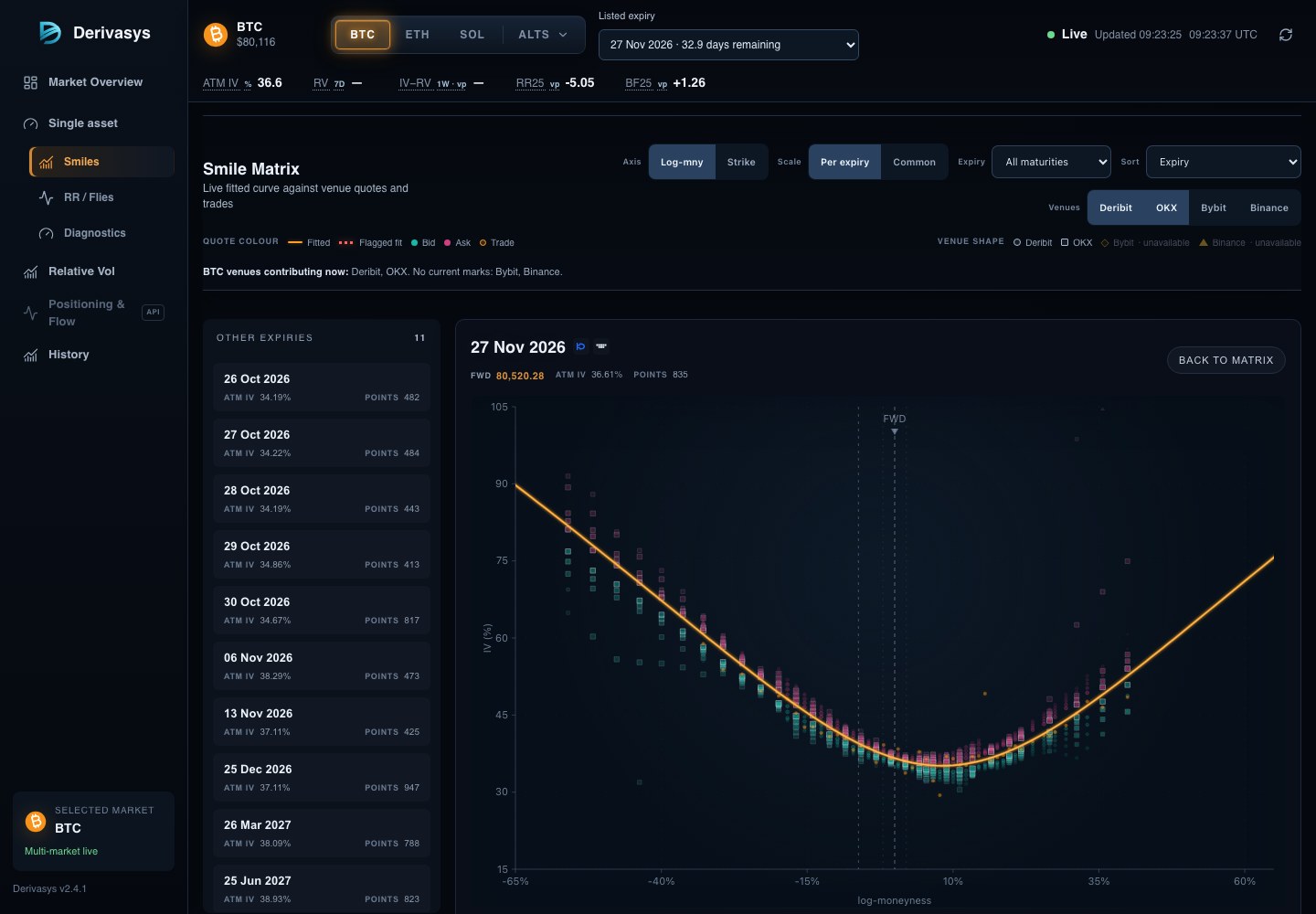
Bid and ask marks show where exchange quotes sit around the fit.
The amber line is our calibrated smile for one expiry.
Venue availability and quote counts show the market data behind the curve.
BTC dashboard capture · · Updated daily. Select the image to enlarge.
Daily and weekly analysis
Snapshot:
Bitcoin (BTC) 1W RR25 fell 1.65 volatility points; Ether (ETH) 1W RR25 fell 2.30 volatility points; Solana (SOL) 1W RR25 fell 2.88 volatility points between the October 23 and October 24 snapshots at 16:31 UTC. The coordinated skew shift favoured puts relative to calls across all three markets. Solana recorded the largest adjustment, while Ether retained the most negative 1W RR25. The accompanying rise in 1W ATM implied volatility was broad but uneven.
Snapshot:
AVAX 1W RR25 skew is 1.09 percent compared with XRP at -0.92 percent.
Snapshot:
The 1W ATM IV comparison shows ETH changed by +9.02 volatility points, compared with XRP which changed by -1.54 volatility points.
ATM implied volatility moved from 56.66% to 54.14% (-2.52 volatility points over 60 minutes).
Verified measurement1M ATM IV at 54.14% · change -2.52 vol pts / 60m
ATM implied volatility moved from 56.66% to 54.14% (-2.52 volatility points over 60 minutes).
SOL 1M ATM IV changed -2.52 volatility points.
volatility points · 60-minute observation window
ATM IV · 1M
Source detector · tool deterministic_detector · evidence ID ca8b477f-175f-48f0-88f5-67dbcfc48aff
Evidence timestamp .
Current 54.14 volatility points · Previous 56.66 volatility points · Recorded change -2.52 volatility points · 60-minute window
Analysis confidence is an assessment signal, not a calibrated probability.
SOL 1M ATM IV changed +2.16 volatility points.
SOL 1M ATM IV changed -2.52 volatility points.
News context: News was checked; no sufficiently relevant context was identified.
Spot Bitcoin ETFs finished the week with about $301 million in net inflows, ending a two-week losing streak, even as two straight days of outflows kept October in the red.
Verification: source reporting. The news feed has not classified this report as confirmed. This does not mean the reported event is still unfolding.
Why it matters: The return to net weekly inflows may indicate renewed demand for spot Bitcoin exposure, while the late-week outflows leave the strength of that shift uncertain.
RR25 moved from +2.51 to -1.46 volatility points over 240 minutes; put implied volatility exceeds call implied volatility.
Verified measurement1M RR25 at -1.46 vol pts · change -3.97 vol pts / 240m
RR25 moved from +2.51 to -1.46 volatility points over 240 minutes; put implied volatility exceeds call implied volatility.
SOL 1M RR25 changed -3.97 volatility points.
volatility points · 240-minute observation window
RR25 · 1M
Source detector · tool deterministic_detector · evidence ID c0e929d0-750f-4d58-8eaa-ff36ea210679
Evidence timestamp .
Current -1.46 volatility points · Previous 2.51 volatility points · Recorded change -3.97 volatility points · 240-minute window
Analysis confidence is an assessment signal, not a calibrated probability.
News context: News was checked; no sufficiently relevant context was identified.
Latest detected observation . Latest analyzed market event .
Checks automatically every 30 seconds while this tab is visible.
Editorial review is up to date. Checked 25 Oct 2026, 14:50 UTC.
For dated market-wide context, read the major-coins reports and evidence.
For developers and quant teams
Query published daily implied volatility, skew, butterfly and realised-volatility metrics across seven assets. The public JSON API requires no account or API key.
Beta WebSocket evaluation is available by request. Live-surface REST behavior remains in testing, is supplied only under evaluator-specific terms, and is not generally available.