
The core idea
A volatility smile is implied volatility across strikes for one expiry.
Start with implied volatility for each option. Keep the expiry fixed. Plot IV against strike, moneyness, or delta. The resulting curve is the volatility smile.
Convert prices into IV
Each option price is converted into implied volatility so strikes can be compared on the same scale.
Plot one expiry across strikes
For a single maturity, IV by strike, moneyness, or delta forms the smile.
Fit and extract risk nodes
A smooth smile fit supports risk reversals, flies, interpolation, and surface construction.
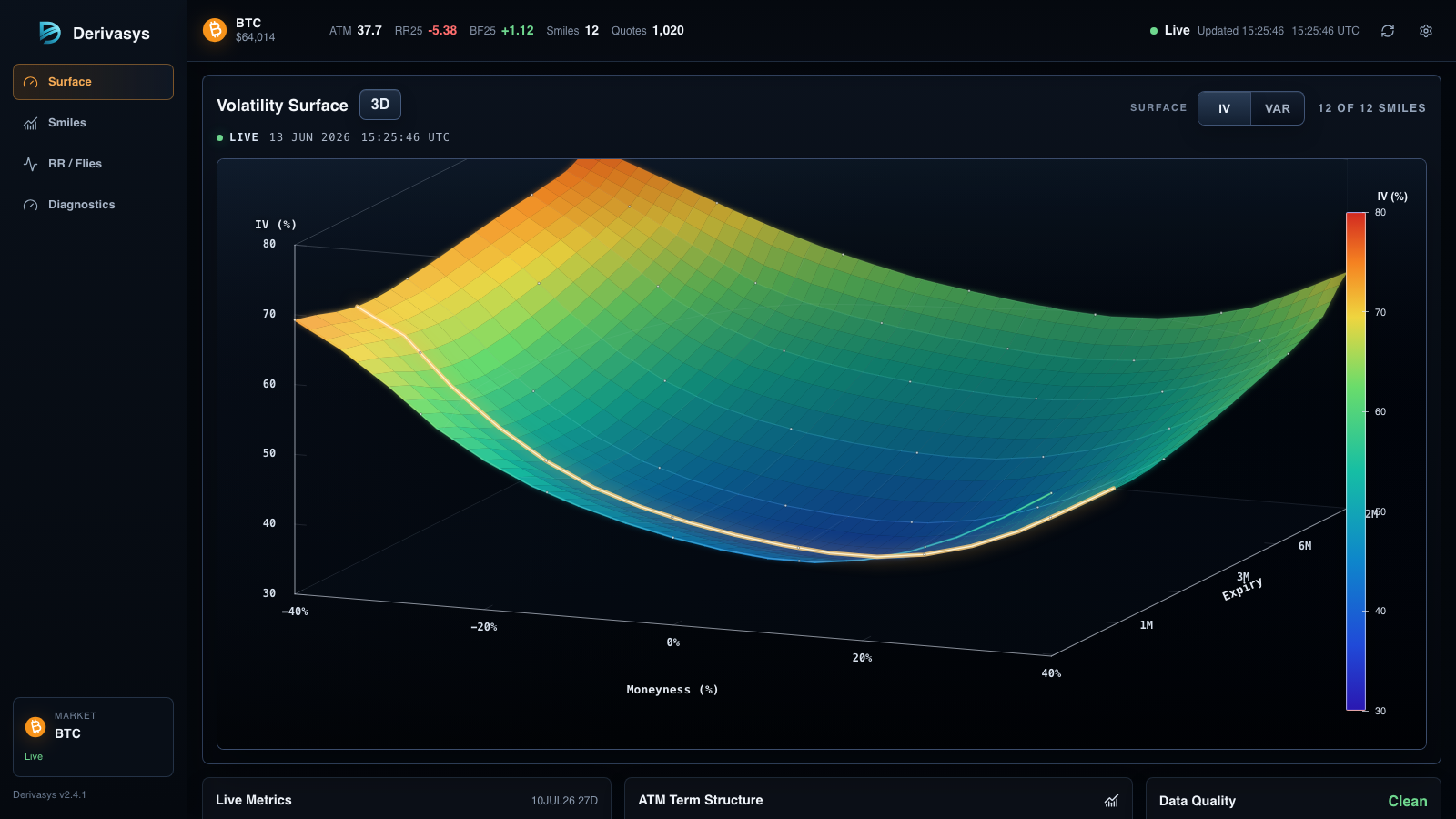
A volatility surfaceis the connected set of many expiry smiles. The surface is what lets a desk compare front-end skew, longer-dated wings, and live quote quality in one market state.
Formula
The smile is a one-expiry function of strike or moneyness.
The raw smile is a set of market IV points. Production systems usually fit those points with a controlled curve so the dashboard can interpolate between strikes and extract stable risk nodes.
Smile parts
Traders read the body, wings, skew, and curvature.
The shape matters because it captures how the market prices different parts of the payoff distribution. In crypto options, sparse strikes and fast-moving forwards make it especially important to keep smile points tied to live venue context.
ATM level
The body of the smile near the forward or ATM strike. Desks often track this as the headline volatility for an expiry.
Put wing
The downside side of the smile. In BTC and crypto options, this wing is often important for crash protection and skew monitoring.
Call wing
The upside side of the smile. It helps show whether convex upside demand is rich or cheap against downside protection.
Curvature
The bend from ATM into the wings. Flies summarize this curvature in a compact trader-facing number.
Strike, moneyness, delta
The same smile should be reviewable in listed-strike and risk-node coordinates.
A smile is one expiry slice, but the x-axis changes the question being asked. Strike view is closest to the listed instrument. Moneyness view keeps the expiry forward explicit. Delta view lines the smile up with risk reversals, flies, and sticky-deltascenarios.
Strike view
Useful for listed option monitoring because the instrument strike is fixed and easy to reconcile with exchange marks.
Moneyness view
Useful for comparing smiles after the forward moves because strikes are normalized around the expiry forward.
Delta view
Useful for trader risk nodes because 25-delta calls and puts can be compared across expiries and market levels.
Total variance view
Useful for SVI calibration because the model fits total implied variance across log-moneyness for one expiry.
SVI fitting
SVI gives the smile a stable total-variance shape.
A raw smile can be noisy, sparse, or inconsistent. SVI fits total implied variance across log-moneyness for one expiry, producing a smoother curve for interpolation, surface construction, diagnostics, and variance swapinputs. SSVI extends that thinking across maturities, while SABRexplains a smile from stochastic forward and volatility dynamics.
Read the SVI formula guideCalibration workflow
A production smile is an accepted market state, not just a smooth curve.
In live crypto options, smile calibration starts before the optimizer. The workflow has to preserve venue evidence, forward context, quote rejection reasons, and residuals so the fitted curve can be trusted by SVI, SSVI, variance, and Greek workflows.
Clean quote marks
Reject stale, crossed, or off-market venue marks before fitting the smile; otherwise one bad wing can move the entire curve.
Fit the expiry slice
Fit the accepted points in total-variance space so interpolation, risk nodes, and surface construction use a coherent curve.
Extract trader nodes
Publish ATM, same-delta risk reversals, flies, and wing slopes beside the fitted smile and quote residuals.
Compare neighboring expiries
A smile can pass per-expiry checks but still look wrong against nearby maturities, fixed-tenor rows, or forward volatility.
venue marks -> accepted IV points -> SVI fit -> residual checks -> risk nodes -> surface sliceRisk nodes
Risk reversals and flies summarize the smile.
A risk reversal compares same-delta call and put IV to read signed skew. A fly compares the average wing IV with ATM IV to read curvature. Both are compact ways to monitor a fitted smile across expiries.
25-delta nodes
The 25-delta smile nodes should carry their source convention.
Same-delta nodes are compact, but they are not raw exchange fields. A production smile workflow has to derive them from the fitted curve using a known forward, delta convention, option type, and source smile version.
25-delta put and call IV
A same-delta pair should be read from the fitted smile with the expiry forward, delta convention, and option type held explicit.
Risk reversal
RR25 is the 25-delta call IV minus the 25-delta put IV, so it is the signed skew summary of the smile.
Fly
BF25 compares the average 25-delta wing IV with ATM IV, so it is the compact 25-delta butterfly (fly) summary of the smile.
Source labels
Each node should identify whether it came from a quoted strike, interpolation, extrapolation, or a held previous smile.
RR25 = IV(call 25d) - IV(put 25d), BF25 = 0.5 * (IV(call 25d) + IV(put 25d)) - IV(ATM)Wing scenarios
Smile moves should identify whether level, skew, or curvature changed.
Two smiles can have the same ATM volatility and very different risk. The useful dashboard question is whether the body moved, the put wing steepened, the call wing was bid, or both wings richened against ATM. That distinction matters for vega and volga, variance estimates, and sticky-strike versus sticky-delta scenarios.
Put-wing steepening
Downside protection gets richer relative to the call wing, usually showing up as a more negative risk reversal.
Call-wing bid
Upside convexity gets richer, which can flatten or invert the usual skew and move same-delta call nodes.
Curvature richening
Both wings rise against ATM, increasing fly values and making variance-swap estimates more sensitive to wing policy.
ATM repricing
The whole smile can move higher or lower while skew and curvature stay stable; this is a different risk from wing rotation.
Fit diagnostics
A volatility smile is publishable only when the fit explains the quotes.
Production smile fitting is not just drawing a smooth curve through points. The fit must preserve market information, reject stale or crossed quotes, and keep wing behavior stable enough for risk nodes and downstream surface consumers. Smile residuals and smile quote quality should be visible beside the accepted curve.
Quote-through-fit residuals
Compare each venue IV mark with the fitted curve. A smile can look smooth while one wing is far away from traded quotes.
Forward and moneyness sanity
The same strike can move across moneyness buckets when the forward changes, so the smile must keep the expiry forward explicit.
Wing slope bounds
Put and call wings should not explode just because one stale quote entered the fit. Production smiles need configured wing guardrails.
Risk-node stability
ATM IV, 25-delta risk reversal, and 25-delta fly should move with market evidence, not optimizer noise.
Derivasys treats the smile as an operational state: quote marks, fit residuals, risk reversals, flies, and expiry context are reviewed together before a slice becomes part of the live volatility surface.
API output
A volatility smile API should expose inputs, fit state, residuals, and derived nodes.
A smile endpoint is more useful when it returns the evidence behind the curve, not only the plotted line. API consumers need to know which quote points were accepted, which coordinate view was used, what the fitted model did, and whether risk nodes came from live quotes or interpolation.
currency, venue mix, expiry, forward, coordinate view, source surface id, fit timestamp, and model family.
strike, option type, mark source, implied volatility, total variance, freshness, spread, and quote-quality flags.
SVI or model parameters, interpolation grid, residual summary, wing slopes, and fit status.
ATM IV, 25-delta put/call IV, risk reversal, fly, wing contribution, and any held-back or stale-node reason.
This is where the smile guide connects back to order-book construction, implied volatility, SVI calibration, and production monitoring. The same source labels should travel through the dashboard and any API-ready surface snapshot.
Failure modes
Smile diagnostics should make bad coordinates, stale wings, and extrapolation visible.
The dangerous smile is not always the jagged one. A smooth fit can be wrong if it is built from stale marks, mismatched forwards, hidden interpolation, or inconsistent coordinate conventions. Those conditions should be visible before the smile drives risk reversals, flies, variance swaps, Greeks, or surface snapshots.
Forward mismatch
If the forward used for moneyness differs from the forward used for IV inversion, the smile can look like skew moved when the coordinate system moved.
Hidden interpolation
A smooth curve can hide a gap between live strikes. Risk nodes should label interpolation and extrapolation rather than pretending every point was quoted.
Wing overreaction
A stale far-wing mark can rotate the fit and move risk reversals, flies, and variance estimates unless quote quality feeds the calibration weights.
Coordinate confusion
Strike, moneyness, and delta views answer different questions. Mixing them in one report can make scenario moves look inconsistent.
Dashboard screenshots
Live smile views should keep quote evidence beside risk-node summaries.
The screenshot views below show why a smile page should link into SVI, risk reversals, and flies: all three are different readings of the same fitted expiry slice.


Live marks versus fitted curve
Show quote points and the fitted smile together so users can see when a curve is interpolating, extrapolating, or disagreeing with venues.
Risk nodes next to the smile
Risk reversals and flies summarize the same smile, so they should sit close to the fit diagnostics instead of being isolated metrics.
Expiry-by-expiry comparison
A volatility surface is built from many smiles. A dashboard should make it easy to spot one expiry that is out of line with its neighbors.
Publish or hold back
If a smile fit fails residual, wing, or term-structure checks, the dashboard should expose the reason rather than silently publishing it.
Topical path
Move from one smile into the full surface workflow.
- Implied volatility: Start with the option-price-to-IV conversion.
- SVI: Fit the smile with a stable total-variance parameterization.
- SSVI: Connect expiry slices into an arbitrage-aware surface shape.
- SABR: Compare a dynamic smile model with direct SVI smile fitting.
- Variance swaps: Use the fitted smile as an input to implied-variance estimates.
- Option Greeks: Connect smile shape to delta, gamma, vega, and theta risk.
- Sticky strike vs sticky delta: Choose whether scenarios keep listed strikes or delta buckets fixed.
- Local volatility: Understand what a smooth smile surface implies for model dynamics.
- Risk reversal: Read signed skew from put and call wings.
- Fly: Read smile curvature from wings versus ATM.
- Dashboard: Monitor live smiles, surfaces, and diagnostics.
- Order-book construction: Trace smile quality back to the quote-state events and venue marks that feed IV inversion.
- Production monitoring: See how fit residuals, stale wings, and risk-node freshness should be monitored.
FAQ
Common questions about volatility smiles.
What is a volatility smile?
A volatility smile is the curve of implied volatility across strikes, moneyness, or delta for one option expiry.
How is a volatility smile different from a volatility surface?
A smile is one expiry slice. A volatility surface connects many smiles across expiries so traders can inspect both strike shape and term structure.
Why is it called a smile?
In many markets, out-of-the-money puts and calls trade at higher implied volatility than ATM options, making the curve bend upward at the wings.
Where does SVI fit into a smile?
SVI fits total implied variance across log-moneyness for one expiry, giving the smile a stable mathematical shape before it is used inside a surface.
Is skew the same as a volatility smile?
No. Skew is one directional feature of the smile, usually read from the relative richness of the put wing and call wing. The full smile also includes ATM level and curvature.
How does a dashboard use a volatility smile?
A dashboard uses the fitted smile to interpolate between strikes, derive risk reversals and flies, compare venue marks with the fit, and assemble many expiry slices into a volatility surface.
Should a smile be plotted by strike, moneyness, or delta?
All three views are useful. Strike is closest to the listed instrument, moneyness normalizes around the forward, and delta is often best for trader risk nodes such as 25-delta risk reversals and flies.
Why do smile wings matter?
The wings show how the market prices tail outcomes. They drive skew, flies, variance estimates, and stress scenarios, so stale or sparse wing quotes should be visible in the fit diagnostics.
How do risk reversals and flies come from the smile?
A risk reversal compares same-delta call and put implied volatility from the fitted smile, while a fly compares the average same-delta wing volatility with ATM volatility.
What should a volatility smile API include?
A volatility smile API should include the expiry forward, coordinate convention, accepted quote points, model parameters, residual diagnostics, ATM IV, same-delta risk nodes, source surface id, and fit status.
Why can a smooth smile still be risky to publish?
A smooth smile can be fitted from stale wings, sparse strikes, a mismatched forward, or heavy extrapolation. Production systems should publish diagnostics and holdback reasons beside the curve.
References
Related Derivasys guides.
- Live Solana options volatility surface
- Derivasys implied volatility guide
- Derivasys volatility surface guide
- Derivasys SVI guide
- Derivasys SSVI guide
- Derivasys SABR guide
- Derivasys variance swaps guide
- Derivasys option Greeks guide
- Derivasys risk reversal guide
- Derivasys volatility fly guide
- Sticky strike vs sticky delta
- Derivasys local volatility guide
- Derivasys order-book construction article
- Derivasys production monitoring article