
The core idea
Implied volatility translates option prices into a volatility scale.
Options trade as prices, but desks often need to compare them as volatility. Implied volatility is the volatility input that makes a pricing model reproduce the current option price. If two BTC options have different strikes or expiries, their dollar prices are not directly comparable. Their implied volatilities are much easier to compare.
Start with a traded option price
Use a clean bid, ask, mark, or trade price together with the strike, expiry, forward, and option convention.
Invert the pricing model
Find the volatility input that makes the model price match the observed market price.
Compare IV across strikes and expiries
Once every option is expressed as implied volatility, smiles, surfaces, skew, and risk nodes become comparable.
In Derivasys, IV is the first step in the path from raw exchange quotes to the volatility surface, volatility smile, SVI fit, and live dashboard.
Formula
IV is solved by matching the model price to the market price.
The pricing model can be Black-Scholes-style or another model appropriate for the market convention. The important point is that implied volatility is an output of inversion, not a price that appears on the exchange order book by itself.
Price selection
Implied volatility is only as clean as the option price sent into the solver.
A live IV worker should not treat every exchange number as the same object. Bid IV, ask IV, mark IV, trade IV, and mid IV can answer different questions. The chosen price should be explicit before that point enters the smile, SVI fit, or downstream dashboard risk node.
Bid, ask, mark, and trade are different signals
A mid price is useful for smooth monitoring, while a last trade may be stale and a mark may include venue methodology.
Forward and discounting must match the expiry
Crypto option IV is distorted if the solver uses a different forward than the futures, basis, or settlement convention behind the quote.
No-arbitrage bounds catch impossible prices
An option price below intrinsic value or above a practical upper bound should be rejected before any volatility solve.
Quote provenance should travel downstream
The fitted smile should know whether an IV point came from bid, ask, mid, mark, trade, or a fallback value.
IV inversion
Implied volatility calculation is a guarded model inversion.
In a production crypto options pipeline, IV calculation starts with the cleaned quote state from the order book. The worker has to choose a price, check basic bounds, solve for the volatility input, and publish diagnostics so downstream SVI and dashboard consumers know whether the point is trustworthy.
Newton-style solvers are fast when the option has useful vega, but far wings, stale marks, and near-expiry options can make the solve unstable. Derivasys treats those cases as data-quality signals: fallback method, iteration count, residual, and reject reason travel with the IV point.
Use clean option inputs
The inversion needs a coherent option price, strike, expiry, forward, option type, and settlement convention before a volatility number is meaningful.
Bracket the volatility solve
Production IV workers should reject impossible prices and search inside bounded volatility ranges instead of letting the solver wander.
Fallback when vega is weak
Newton steps are fast near liquid strikes, but deep wings and very short expiries often need bisection or a guarded fallback.
Publish diagnostics with the IV
A dashboard should know whether an IV point came from a clean solve, a fallback, a reused value, or a rejected quote.
quote = clean_option_quote(book_state)
price = choose_mark_price(quote.bid, quote.ask, quote.mark)

if price_outside_no_arbitrage_bounds(price, quote):
    reject_iv(reason="bad_price")
else:
    iv = newton_solve(price, quote, seed=previous_iv)

    if not iv.converged or quote.vega_is_weak:
        iv = bisection_solve(price, quote, low=0.01, high=5.00)

    publish_iv(iv, diagnostics={method, iterations, residual})
This is why implied-volatility calculation links directly to order book construction andproduction monitoring. A clean surface starts with a clean IV solve, not only a smooth SVI curve.
Solver diagnostics
IV solves should publish method, residual, bounds, and reject reason.
The most useful IV number is not just the final volatility. It is the volatility plus context: whether Newton converged, whether bisection was needed, whether the value hit a bound, and whether the quote should be excluded from the fitted smile. In practice, the implied volatility solver should publish IV solve diagnostics with every accepted or rejected point.
Weak vega
Deep OTM options and near-expiry options can have very low vega, so tiny price noise can create large IV changes.
Bad seed
Using the previous solve is fast, but a large market move can make the initial guess too far from the new root.
Crossed or stale markets
A crossed book or stale mark can produce an IV that looks numeric but should not be accepted into a live smile.
Boundary solve
If the answer lands on the low or high volatility bound, the dashboard should show that the quote was constrained.
IV state contract
Each IV point should carry quote identity, pricing context, solver telemetry, and publication status.
A raw volatility number is not enough for a live surface. The IV state contract should tell SVI, monitoring, API consumers, and the dashboard exactly which quote, forward, solver path, and publication decision produced the point.
Quote identity
currency, venue, instrument, expiry, strike, option type, chosen price source, and quote-state id.
Pricing context
forward, discounting assumption, time to expiry, contract multiplier, settlement convention, and no-arbitrage bounds.
Solver telemetry
method, seed, iteration count, residual, volatility bounds, fallback path, and elapsed time.
Publication status
accepted, rejected, reused, approximated, held, or stale, with the reason visible to SVI and dashboard consumers.
VolState {
  quote_state_id,
  instrument,
  chosen_price_source,
  forward,
  implied_volatility,
  total_variance,
  solver_telemetry,
  status
}
Cache reuse
IV cache reuse is safe only when the displayed surface would not move.
Reusing a previous IV can protect the event loop during bursty BTC markets, but it is a product decision rather than a simple cache lookup. The cache policy must preserve the fitted smile, same-delta nodes, forward-volatility buckets, and surface health state.
Forward bucket
Reuse a previous IV only when the forward has not moved enough to remap moneyness, delta buckets, or visible risk nodes.
Mark bucket
Round tiny mark changes only when the resulting IV and total variance stay inside dashboard display tolerance.
Quality-state change
Invalidate cached IV when a quote changes from accepted to stale, crossed, one-sided, sequence-stale, or rejected.
Replay check
Compare cached and fully recomputed paths on burst windows before relaxing reuse thresholds.
The performance tuning article explains why selective IV recalculation needs replay checks before it can feed the live dashboard.
API output
An implied volatility API should expose the input quote, solver result, surface links, and replay state.
API consumers need more than IV. They need to know whether a point was accepted, rejected, reused, or held back, and which surface state consumed it. That makes the implied volatility API useful for calibration, monitoring, replay, and downstream risk systems.
quote id, instrument key, bid, ask, mark, chosen price, price source, forward, expiry, strike, and option type.
implied volatility, total variance, vega, solver method, iteration count, residual, status, and reject reason.
source smile id, SVI fit id, risk-node impact, dashboard snapshot id, and surface health state.
book version, forward version, solver version, cache key, and replay id for reproducing the IV point.
Those fields connect IV to smile construction, SVI calibration, surface health monitoring, and the replay path behind Derivasys dashboard snapshots.
Total variance
SVI and forward volatility use IV after converting it to total variance.
Implied volatility is usually annualized. For fitting and term-structure work, Derivasys converts each accepted IV point into total implied variance. That is the quantity raw SVI fits across log-moneyness, and the same scale used when deriving forward volatility.
60% annualized implied volatility
30 / 365 = 0.0822 years
0.60² × 0.0822 = 0.0296
SVI fit, forward vol, variance swaps, and dashboard diagnostics
Why it matters
IV makes the surface readable.
A volatility dashboard needs more than a pile of option prices. It needs a consistent coordinate system where strikes, expiries, risk nodes, and diagnostics can be compared during active markets.
Normalize option prices
A dollar option price depends on strike, expiry, and forward level. IV puts those prices onto a comparable volatility scale.
Read one expiry smile
Implied volatility across strikes shows whether downside puts, ATM options, or upside calls are trading rich.
Build a surface
Connecting IV smiles across expiries creates the volatility surface used for interpolation, monitoring, and risk extraction.
Audit the market state
Live IV can expose stale quotes, crossed markets, bad forwards, or model inputs that would distort the fitted surface.
Surface workflow
One IV point becomes useful when it is placed inside the smile.
For one expiry, implied volatility across strikes forms the volatility smile. Fit that smile with SVI, connect smiles across expiries, and the result becomes a production volatility surface.
From there, desks usually extract stable nodes rather than read every strike manually. A risk reversal summarizes signed skew, while flies summarize smile curvature.
IV point
One clean option quote is inverted into implied volatility with solve diagnostics.
Smile point cloud
Accepted IV points across one expiry become the point cloud for a volatility smile.
SVI slice
The smile is fit in total variance space so risk nodes and interpolation are stable.
Surface state
Connected expiry slices become the dashboard surface used for risk reversals, flies, forwards, and APIs.
Dashboard screenshots
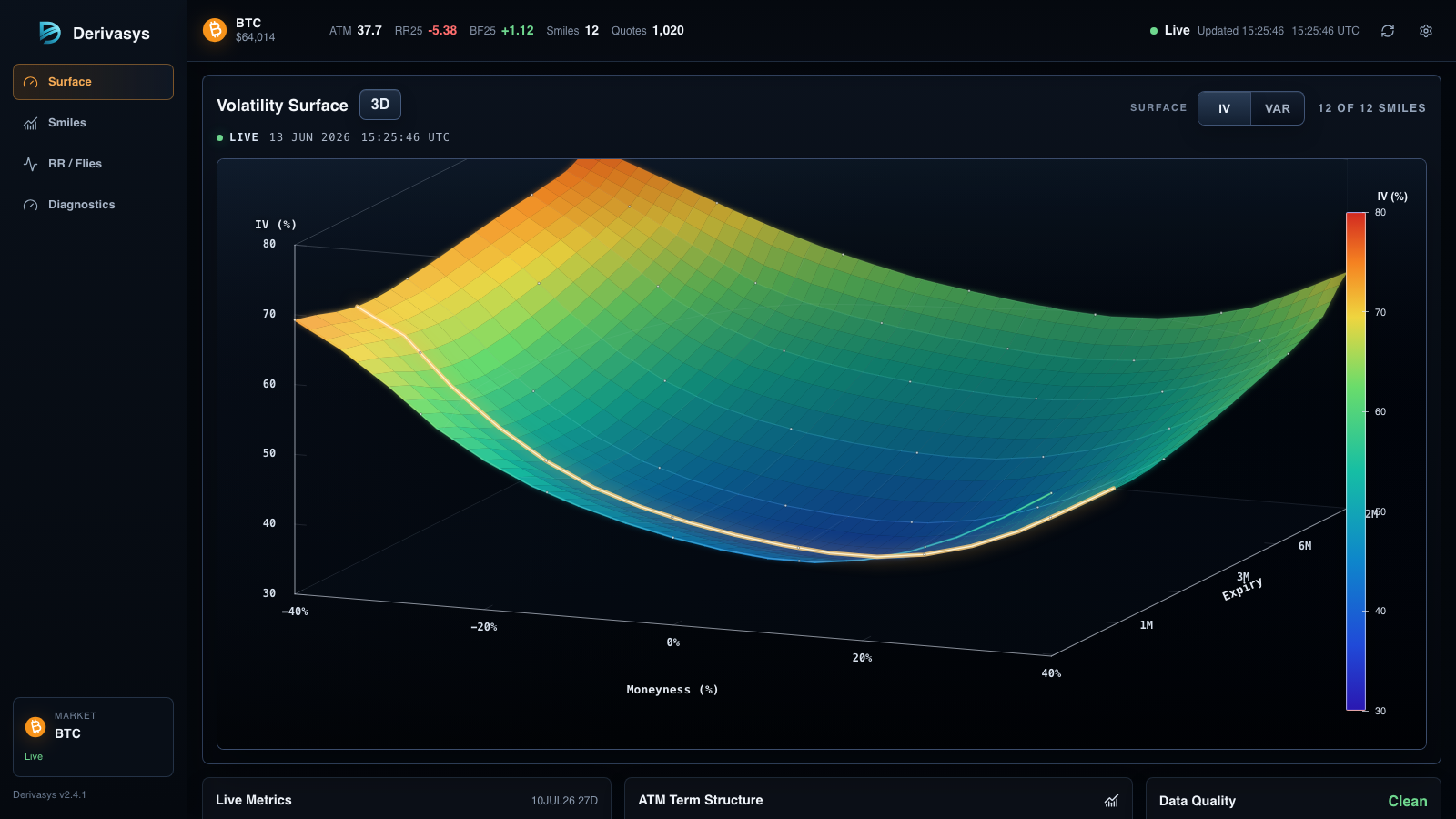
Live IV is useful when the quote, fit, and diagnostics stay visible.
Implied volatility should not be a detached number. The dashboard keeps IV-derived smiles beside risk nodes, quote-through-fit checks, and volatility surface diagnostics so users can see whether a move came from market structure or bad input data.


Topical path
Move from IV into the live dashboard workflow.
- Volatility surface: See where implied volatility fits in the full surface workflow.
- Forward volatility: Convert expiry IV into total variance and compare future windows.
- Option Greeks: See how IV, forwards, and time feed delta, gamma, vega, and theta.
- Variance swaps: Move from implied volatility to implied variance and realized-variance payoffs.
- Volatility smile: Move from one IV point to a full expiry curve.
- SVI: Fit the smile with a stable total-variance model.
- SSVI: Tie accepted IV slices into a surface-level total-variance shape.
- Order book construction: See the quote-state contract used before IV inversion.
- Production monitoring: Monitor solver failures, stale IV points, and surface health status.
- Performance tuning: See why IV inversion became the live BTC options bottleneck.
- Risk reversal: Turn the fitted smile into a signed skew node.
- Local volatility: See how a smooth IV surface feeds model-dynamics diagnostics.
- Dashboard: Inspect live IV, fitted smiles, risk nodes, and diagnostics.
FAQ
Common questions about implied volatility.
What is implied volatility?
Implied volatility is the volatility input that makes an option pricing model match the observed market price for an option.
Is implied volatility the same as realized volatility?
No. Realized volatility measures how the underlying has moved historically. Implied volatility is inferred from current option prices and reflects market expectations, supply, demand, and risk premia.
Why do options with different strikes have different implied volatility?
Markets usually price downside, upside, and ATM options differently. That strike-by-strike pattern is the volatility smile.
How is implied volatility calculated?
Implied volatility is calculated by solving for the volatility input that makes the pricing model match the observed option price. Production systems usually bracket the solve, use Newton steps when stable, and fall back to bisection when vega is weak.
Why does implied volatility get converted to total variance?
SVI and term-structure checks usually work in total variance, which is implied volatility squared times time to expiry. That makes expiry slices easier to fit and compare.
Why does Derivasys monitor implied volatility instead of only option prices?
IV makes BTC and crypto options easier to compare across strikes and expiries, then feeds the live smile, surface, SVI, risk reversal, and fly workflow.
Why can implied volatility fail to solve?
An IV solve can fail when the option price is outside model bounds, the quote is stale or crossed, vega is too weak, or the solver reaches its volatility limits.
Which option price should be used for implied volatility?
Production systems usually distinguish bid IV, ask IV, mark IV, trade IV, and mid IV. The right input depends on whether the use case is monitoring, execution, calibration, or risk.
What should an implied volatility API include?
An implied volatility API should include quote identity, price source, forward, expiry, solver method, residual, status, total variance, source smile id, dashboard snapshot id, and replay identifiers.
When is it safe to reuse a previous IV?
A previous IV can be reused only when the quote, forward bucket, mark bucket, and quality state have not changed enough to move the displayed smile, risk nodes, or total variance materially.
Why does solver telemetry matter?
Solver telemetry shows whether an IV point came from a fast Newton solve, guarded fallback, cache reuse, approximation, or rejection, which keeps SVI calibration and monitoring auditable.
References
Related Derivasys guides.
- Live Solana options volatility surface
- Derivasys volatility surface guide
- Order book construction for crypto options
- Production monitoring for crypto volatility surfaces
- Derivasys forward volatility guide
- Derivasys option Greeks guide
- Derivasys variance swaps guide
- Derivasys volatility smile guide
- Derivasys SVI guide
- Derivasys SSVI guide
- Derivasys local volatility guide
- Derivasys risk reversal guide
- Real-time BTC options surface engineering article