
Definitions
The difference is what you hold fixed after the forward moves.
Both conventions start from the same volatility smile. The disagreement begins when the forward changes and a desk needs a quick scenario rule before running a full volatility surfacerecalibration.
Sticky strike
Implied volatility is treated as fixed for each absolute strike. When the forward moves, that strike has a new moneyness and delta.
Useful when the question is how listed strike marks behave around the current order book.Sticky delta
Implied volatility is treated as fixed for each delta or moneyness bucket. The strike moves with the forward to keep the bucket comparable.
Useful for risk reports, scenario grids, and smile dynamics where desks discuss 25-delta or 10-delta nodes.Coordinate system
SVI makes the distinction explicit because the smile is fit in log-moneyness.
If the strike is fixed, k changes as the forward changes. If the delta bucket is fixed, k is held approximately constant and the strike rolls with the forward.
Sticky strike
k=ln(KF)Sticky delta
K=FekForward-shock example
The same starting option becomes two different scenario objects after the forward moves.
Suppose BTC forward starts at 100,000 and a listed 95,000 strike sits around k = ln(95,000 / 100,000), or -5.13% log-moneyness. If the forward jumps to 110,000, sticky strike and sticky delta answer different questions.
Forward 100,000, strike 95,000, log-moneyness -5.13%, near a comparable put-wing node.
After the forward moves to 110,000, the strike remains 95,000 and log-moneyness moves to -14.65%.
The node keeps log-moneyness near -5.13%, so the comparable strike rolls to about 104,500.
The first view explains listed-strike marks; the second explains comparable smile nodes and delta-bucket risk.
Sticky strike keeps the listed order-book coordinate fixed. Sticky delta keeps the comparable smilecoordinate fixed. Neither is a replacement for a full surfacerevaluation when the market actually reprices.
Desk usage
Use the convention that matches the operational question.
Listed markets
Sticky strike is closer to asking what happens to visible order-book marks.
A fixed strike can move from near-ATM to wing territory as the forward changes. That matters for quote-through-fit checks and strike-level monitoring.
Risk reports
Sticky delta is closer to asking what happens to a comparable smile node.
A 25-delta put remains a 25-delta put, but the strike that represents that node changes as the forward changes.
Production
Derivasys keeps both views inspectable beside fitted SVI state.
Native expiry smiles, fixed-tenor rows, risk nodes, and quote diagnostics make the convention visible rather than hidden inside a scenario label. The same delta buckets feed risk reversalsand flies.
When conventions fail
Sticky strike and sticky delta are scenario shortcuts, not live-market truth.
A sticky convention is useful only while the source smile remains a reasonable starting point. Once the market has traded through the old fit, the correct workflow is to rebuild the SVI slice, inspect quote-through-fit residuals, and compare the scenario with a fresh surface. This is especially important around short expiries where the delta-to-strike mapping can change faster than the dashboard refresh cadence.
Large repricing
If venue marks have clearly moved, neither sticky strike nor sticky delta should be presented as a market value. The surface needs a fresh fit.
Short-expiry jumps
Near expiry, a small forward move can remap strikes across delta buckets quickly. Sticky-delta scenarios need tighter timestamps and expiry-level warnings.
Sparse wings
If one wing is quote-light, a sticky-delta node may be mostly interpolation. The scenario should show quote coverage and through-fit residuals.
Volatility-dependent delta
Delta is not only a function of strike and forward. Volatility, expiry, and option convention can change the strike that represents a bucket.
Delta remapping
Sticky delta requires a reproducible mapping from forward shock to new strike.
The important implementation detail is that a delta bucket is not a raw strike. A 25-delta put node used in risk reversals and flies should be rebuilt from the same source smile, forward shock, delta convention, and interpolation rule. Otherwise a dashboard can show coherent numbers that were actually produced from mixed assumptions.
Start with accepted state
Read the source forward, SVI slice, ATM level, delta convention, and timestamp from the accepted surface snapshot.
Apply the forward shock
For sticky strike, keep K fixed and recompute k. For sticky delta, keep the target bucket and solve for the new representative strike.
Carry the scenario label
The output should remain labelled as scenario data, not live market data, even when it is displayed beside real venue marks.
Rebuild dependent nodes
Risk reversals, flies, Greeks, and fixed-tenor rows should use the same scenario convention or stay explicitly unshocked.
source surface -> forward shock -> target delta bucket -> remapped strike -> scenario smile node
This is a different object from local volatility, which tries to describe spot-and-time dynamics from an arbitrage-aware surface. Sticky delta is a practical scenario convention for comparing smile nodes before the next full revaluation.
Dashboard workflow
Scenario conventions should be visible beside the fitted surface.
Sticky strike and sticky delta are not just textbook labels. They change how a dashboard explains a forward shock. The same fitted SVI smile can produce a strike-level view for listed books, a delta-node view for risk reversals, and a scenario view for Greekreports.
State the convention
A scenario row should say sticky strike, sticky delta, or full surface revaluation instead of hiding the assumption in the chart title.
Show the moving coordinate
For sticky strike, show how delta and log-moneyness move. For sticky delta, show the strike that rolls with the forward.
Keep risk nodes tied to the smile
Risk reversals, flies, and fixed-tenor rows should point back to the fitted SVI slice that produced them.
Separate scenario from market data
A dashboard should distinguish live venue marks from a forward-shock convention so users do not mistake a scenario for a traded quote.



Forward source
Use the same expiry forward that was used for SVI log-moneyness, risk reversals, flies, and fixed-tenor rows.
Convention enum
Persist sticky_strike, sticky_delta, or full_revaluation as a machine-readable field rather than a chart label.
Scenario lineage
Keep the scenario value linked to the source smile, previous forward, shocked forward, and timestamp.
Risk-node consistency
If a 25-delta node rolls under sticky delta, the related risk reversal and fly should roll from the same convention.
API conventions
API fields should say whether a value is fixed-strike or fixed-delta.
A sticky-delta number without metadata is easy to misuse. A clean API payload should carry the convention, expiry, forward, strike, delta bucket, log-moneyness, source surface, timestamp, and whether the value came from live marks or a scenario.
{
  "scenario_convention": "sticky_delta",
  "expiry": "2026-05-29",
  "forward": 104250,
  "delta_bucket": "25d_put",
  "strike": 92000,
  "log_moneyness": -0.124,
  "source_surface": "btc_svi_live",
  "value_type": "scenario"
}
The same convention label should flow into forward-volatilityreports when the desk compares fixed-tenor rows before and after a spot or forward shock.
Scenario governance
Persist the convention so historical scenarios can be replayed.
Sticky-strike and sticky-delta outputs become operational data once they feed alerts, reports, or API consumers. A stored scenario should keep enough lineage to explain why a strike moved, why a delta bucket stayed fixed, and whether the desk was looking at sticky_delta_v1 or a later convention. That lets the team compare each shortcut with the full revaluation that arrived after the market repriced.
Version the convention
If the desk changes from sticky_delta_v1 to a different delta convention, old scenario outputs need to remain reproducible.
Expose source and shock
A stored scenario should include source snapshot id, original forward, shocked forward, delta bucket, and whether strike or moneyness was held fixed.
Separate display from storage
Dashboard labels can be human-readable, but API and logs need machine-readable enums for analytics and replay.
Compare with full revaluation
When the live market reprices, compare the sticky scenario with the newly fitted SVI surface to see where the convention failed.
Reading path
Move from smile coordinates into dashboard risk workflows.
Sticky strike vs sticky delta sits in the middle of the surface cluster: it uses SVI moneyness, feeds risk reversal and fly nodes, affects Greek reports, and should remain visible in the live dashboard.
SVI
Use log-moneyness to understand why forward moves change the smile coordinate.
Risk reversals
See how fixed delta buckets feed signed skew nodes.
Volatility flies
Follow the same delta convention into smile curvature nodes.
Forward volatility
Connect forward shocks to term-structure and event-window diagnostics.
Local volatility
Contrast sticky scenario conventions with models driven by spot and time dynamics.
Dashboard
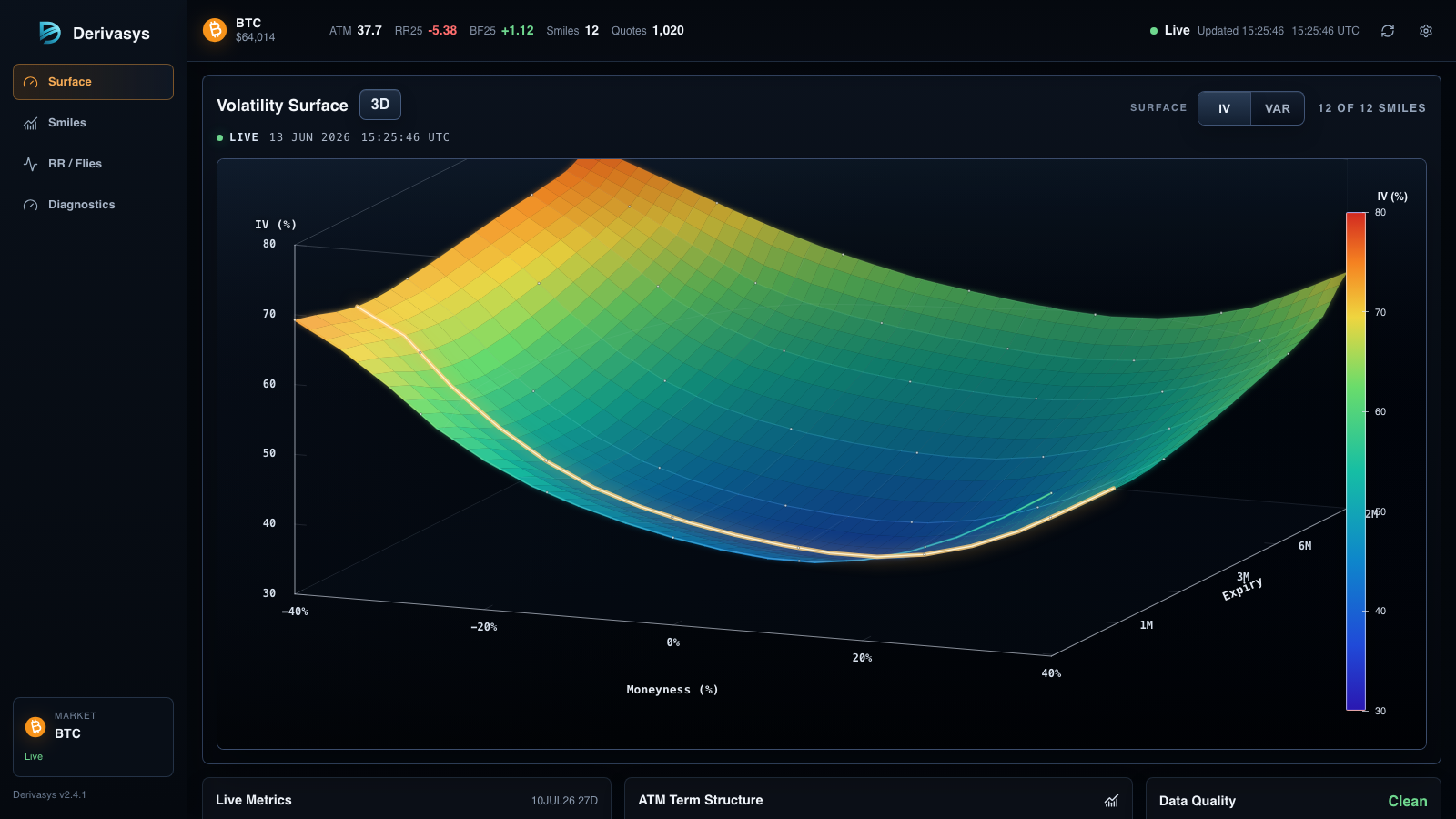
Open the live surface workflow where scenario labels need to stay visible.
FAQ
Common questions.
Which convention is correct?
Neither is universally correct. Sticky strike and sticky delta are scenario conventions. The useful convention depends on whether the problem is listed-strike marking, delta-bucket risk, or a full surface revaluation.
Why does sticky delta move the strike?
Delta is tied to moneyness and forward level. If the forward changes but the delta bucket is held fixed, the strike must roll to stay in the same part of the smile.
How does this connect to SVI?
SVI is usually fit in log-moneyness. Sticky strike changes k = ln(K / F) when F moves, while sticky delta keeps a similar k bucket and changes K.
Should a dashboard show sticky strike or sticky delta?
A volatility dashboard should make the convention explicit. Sticky strike is useful for listed-strike marks, while sticky delta is useful for comparable smile nodes such as 25-delta risk reversals.
What should an API label for sticky delta include?
An API field should include the convention, forward, strike, delta bucket, log-moneyness, expiry, source surface, timestamp, and whether the value is live market data or a scenario.
Is sticky delta the same as sticky moneyness?
They are closely related for scenario analysis because both keep a comparable part of the smile fixed while the strike rolls with the forward. Exact delta also depends on volatility, expiry, and option convention.
What happens to log-moneyness under sticky strike?
Under sticky strike, the listed strike stays fixed and log-moneyness changes when the forward changes. That can move the option from the smile body into a wing.
When does sticky delta break down?
Sticky delta is weakest when the market has repriced, wings are sparse, expiry is very short, or volatility changes enough that the delta-to-strike mapping itself needs a fresh solve.
Should risk reversals and flies use the same sticky convention?
Yes for a coherent scenario. A shocked risk reversal and fly should be rebuilt from the same source smile, forward shock, and sticky-strike or sticky-delta convention.
References
Further reading on smile dynamics.
- Derivasys volatility surface guide
- Derivasys implied volatility guide
- Derivasys volatility smile guide
- Derivasys forward volatility guide
- Volatility smile dynamics and sticky strike/sticky delta conventions
- Smile dynamics and implied leverage effect
- Derivasys SVI guide
- Derivasys SSVI guide
- Derivasys SABR guide
- Derivasys risk reversal guide
- Derivasys option Greeks guide
- Derivasys volatility fly guide
- Derivasys local volatility guide
- Derivasys technical articles