
The core idea
Option Greeks are local risk sensitivities.
An option price is not driven by one input. It depends on the underlying or forward, strike, expiry, rates, and implied volatility. Greeks measure how the model price changes when one input moves while the others are held fixed.
In a live crypto options workflow, Greeks should be read beside the volatility surface. A delta number without the smile, fit quality, and expiry context can hide whether the risk comes from direction, convexity, or volatility.
Core Greeks
Delta, gamma, vega, and theta answer different risk questions.
Delta
Price sensitivity to the underlying or forward.
Direction, hedge size, delta buckets, and risk reversal selection.
Gamma
How quickly delta changes when the underlying moves.
Convexity, hedge frequency, and event-window risk.
Vega
Price sensitivity to implied volatility.
Volatility exposure, surface shocks, and smile-risk monitoring.
Theta
Sensitivity to the passage of time.
Decay, carry, weekend effects, and expiry roll-down.
Rho
Sensitivity to rates or discounting assumptions.
Usually secondary in crypto, but still relevant for long-dated options.
Delta also connects directly to Derivasys risk nodes. A 25-delta risk reversalcompares same-delta call and put implied volatility, while a volatility fly compares same-delta wings with ATM volatility.
Formula view
Most Greeks are derivatives of option value with respect to pricing inputs.
The exact closed forms depend on the pricing model. The practical interpretation is stable: each Greek is a local sensitivity around the current model state.
Often reported per one-vol-point move in implied volatility.
Usually scaled to one day, but crypto desks should define the clock.
Position size, option direction, multiplier, and currency unit all matter.
Crypto checks
Crypto Greeks inherit every issue in the surface and forward inputs.
BTC and ETH options trade continuously, forwards can move with basis and funding, and far-wing liquidity can be sparse. A Greek workflow should therefore inspect the same inputs used for SVI, sticky delta, and fixed-tenor volatility views.
Forward selection
Crypto option deltas are more stable when the expiry forward is clean, especially around futures basis changes and perpetual funding moves.
Volatility source
Vega depends on the volatility input being shocked. Desk reports should state whether shocks apply to raw marks, fitted SVI smiles, fixed-tenor rows, or the full surface.
Time basis
Theta depends on the clock convention. Crypto trades continuously, so calendar-day, hour-by-hour, and settlement-window assumptions can produce different decay reads.
Aggregation signs
Portfolio Greeks must keep long and short option signs explicit. A dashboard number is only useful if position direction, contract multiplier, and currency unit are consistent.
Required inputs
A Greek number is only audit-ready when the input state is visible.
The same option can produce different delta, vega, theta, and second-order Greeks if the forward, volatility source, expiry clock, or surface version changes. A production Greek risk report should therefore carry the market and surface state beside the value.
Contract state
underlying, expiry, strike, option side, contract multiplier, settlement currency, and position sign.
Market state
expiry forward, discounting or carry convention, implied volatility source, timestamp, and quote freshness.
Surface state
SVI slice id, fixed-tenor row, risk-node convention, quote-through-fit status, and accepted surface version.
Scenario state
shock size, sticky-strike or sticky-delta convention, tenor bucket, skew node, and finite-difference step.
Surface shock workflow
Surface-aware Greeks should say exactly what market state was shocked.
A single Greek number is easy to misread unless the shock convention is explicit. A sticky-strike delta, a sticky-deltarepricing, a parallel vega shock, and a skew-node move are different scenarios. Each one should be tied back to the fitted surface and risk-node convention.
Freeze the market state
Record forward, discounting, implied volatility, fitted smile, and timestamp before computing a reported Greek.
Choose the shock convention
Decide whether the scenario is sticky strike, sticky delta, parallel surface shock, tenor shock, or a node-specific skew move.
Reprice the option book
Apply the scenario through the same model and surface inputs used for the base value, then compare base and shocked prices.
Publish provenance
Surface-aware Greeks should carry the source surface, rejected marks, quote-through-fit residuals, and the shock convention used.
base surface -> shock convention -> repriced book -> finite-difference Greek -> risk-node attributionPortfolio aggregation
Portfolio Greeks need unit normalization and tenor attribution.
Aggregating crypto options risk is mostly a metadata problem. The report has to reconcile contract multipliers, settlement currency, inverse or linear payoff treatment, expiry buckets, and volatility units before the numbers are meaningful.
Normalize units first
Convert every contract into the same currency, multiplier, and vol-point convention before adding Greek rows.
Keep expiry buckets visible
A flat portfolio vega can hide offsetting front-end and back-end exposures that behave differently under surface shocks.
Show directional and convex risk together
Delta and gamma should stay near the spot or forward scenario because gamma changes the hedge after the market moves.
Tie vega to the surface node
A vega number should state whether it belongs to a listed expiry, fixed tenor, ATM row, risk reversal, fly, or full-surface shock.
Implementation checks
Production Greek reports need units, second-order risks, and contract metadata.
In crypto options, the most useful Greek report is not just a table of delta, gamma, vega, and theta. It should also show the surface source, shock size, unit convention, contract multiplier, and second-order exposures such as vanna and volga when spot and volatility move together.
Use consistent units
Vega may be reported per 1.00 vol, one vol point, or one basis point of implied volatility. Dashboards and APIs should state the unit.
Separate model Greeks from desk Greeks
Closed-form Greeks are local model derivatives. Desk risk often uses finite-difference shocks on the fitted surface because the surface itself moves.
Watch second-order Greeks
Vanna, volga, charm, and color become important when the book is exposed to both spot moves and volatility-surface moves.
Aggregate with contract metadata
Crypto options need consistent contract multipliers, settlement currency, inverse or linear payoff treatment, and position signs before portfolio Greeks are meaningful.
Risk reversals and flies use delta buckets to compare equivalent smile regions across expiries.
A vega report should show whether the shock is one expiry, one fixed tenor, or the full volatility surface.
Gamma is most useful beside event timing, hedge frequency, and the liquidity available near the strike.
Theta should identify whether the decay convention is calendar day, trading day, or hour-by-hour crypto time.
API fields
An option Greeks API should return units, scenario convention, and diagnostics.
A raw table of Greeks is hard to use safely. API consumers need to know the input surface, whether the numbers are analytic or finite-difference estimates, what units are used, and whether the surface state passed fit-quality checks.
contract id, position, forward, expiry clock, volatility source, surface id, and quote timestamp.
delta, vega, theta, rho, unit convention, shock size, and calculation timestamp.
gamma, vanna, volga, charm, color, and whether values are analytic or finite-difference estimates.
fit health, stale surface flag, rejected marks, interpolation-heavy nodes, and scenario convention.
The same fields are useful inside Derivasys monitoring. The production monitoring article explains why stale surfaces, fit rejects, and quote provenance have to be visible before downstream risk reports consume a surface.
Failure modes
Most Greek-reporting errors come from units, stale inputs, or hidden scenario assumptions.
The calculation can be mathematically correct and still be operationally misleading if the report hides the surface, scenario, and unit assumptions behind it.
Vega unit mismatch
Combining per-1.00-vol vega with per-vol-point vega can make portfolio risk off by a factor of 100.
Sticky convention drift
A reported delta can change when the system silently switches between sticky-strike and sticky-delta repricing.
Stale surface inputs
A Greek report can look current while the SVI slice, forward, or wing quotes used for the calculation are stale.
Hidden interpolation
A Greek at a sparse strike or tenor can depend mostly on interpolation, so the report should expose source-node distance.
Dashboard workflow
Derivasys keeps Greek inputs near the surface diagnostics.
The public dashboard focuses on fitted SVI smiles, risk reversals, flies, fixed-tenor rows, quote-through-fit checks, and surface diagnostics. Those are the inputs that make a Greek number auditable instead of just a model output.

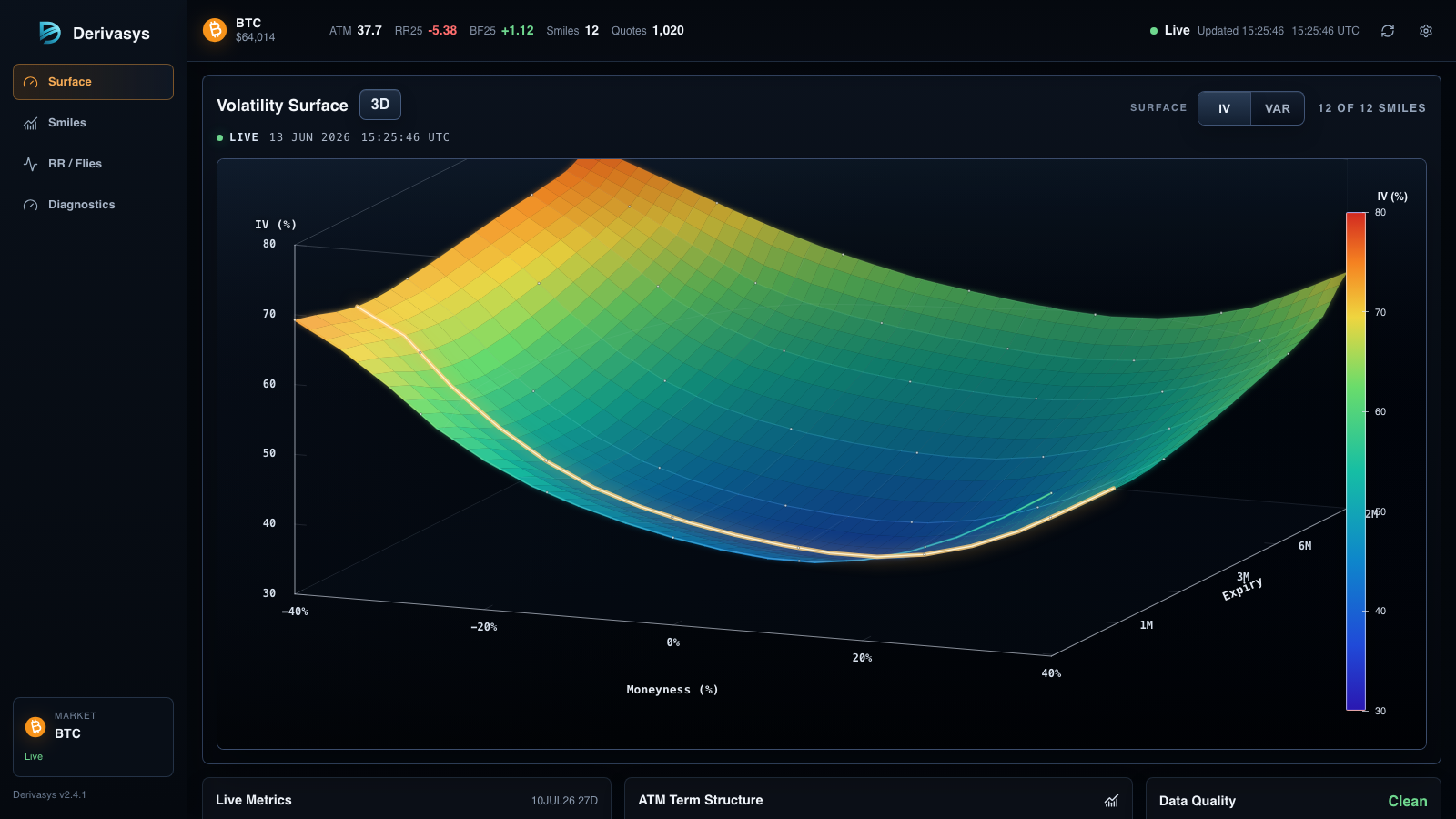
Dashboard screenshots
Greek workflows are easier to audit when risk nodes and surface state stay visible.
Derivasys exposes the fitted volatility surface and the risk-reversal/fly panels that Greek scenario workflows depend on. Those views make delta buckets, vega shocks, skew nodes, and fixed-tenor diagnostics reviewable before the numbers are used in a downstream portfolio report.

Reading path
Move from pricing inputs into surface risk nodes.
Greeks depend on option pricing inputs and implied-volatility assumptions.
Read nextUse the surface to understand how Greeks vary across strike and expiry.
Read nextUse total variance and forward buckets to interpret vega and theta by tenor.
Read nextDelta buckets turn the surface into signed skew nodes.
Read nextSame-delta wings and ATM volatility turn smile curvature into a risk node.
Read nextScenario conventions decide whether strike or delta buckets stay fixed.
Read nextA fitted smile gives stable inputs for delta buckets and volatility shocks.
Read nextSurface-level SVI checks help keep Greek inputs coherent across expiries.
Read nextFAQ
Common questions about option Greeks.
What are option Greeks?
Option Greeks are risk sensitivities that estimate how an option price changes when inputs such as underlying price, volatility, time, or rates change.
Which Greeks matter most for crypto options?
Delta, gamma, vega, and theta are usually the main Greeks. Rho is often smaller for short-dated crypto options, but it can matter for longer expiries and discounting choices.
How are Greeks connected to implied volatility?
Greeks come from an option pricing model. Vega directly measures sensitivity to implied volatility, while delta and gamma also change when the implied-volatility surface moves.
Why do risk reversals use delta?
Delta buckets compare similar parts of the smile across expiries and market levels. A 25-delta risk reversal compares the 25-delta call and 25-delta put.
Does Derivasys calculate portfolio Greeks?
Derivasys focuses the public dashboard on live surfaces, SVI smiles, risk nodes, and diagnostics. Those surface inputs are the foundation for Greek and scenario workflows.
Why can Greeks change when implied volatility changes?
Greeks are computed from a pricing model and a market state. If the fitted implied-volatility surface moves, delta, gamma, vega, and second-order Greeks can all change even when the listed strike is unchanged.
What is the difference between model Greeks and scenario Greeks?
Model Greeks are local derivatives around one model state. Scenario Greeks or finite-difference risks reprice the book after a defined spot, volatility, skew, tenor, or surface shock.
What should an option Greeks API include?
An option Greeks API should include contract identity, position, forward, volatility source, surface id, shock convention, units, first-order Greeks, convex risks, timestamps, and fit diagnostics.
Why do portfolio Greeks need surface metadata?
Portfolio Greeks can hide offsetting exposures across expiries, strikes, delta buckets, or volatility tenors. Surface metadata shows which smile, tenor, and scenario convention produced each risk number.
What is vanna and volga?
Vanna measures how delta changes as implied volatility moves, while volga measures how vega changes as implied volatility moves. They matter when spot and volatility can move together.
References