
The core idea
Forward volatility is implied volatility for a future time bucket.
A quoted implied volatility belongs to one expiry. Forward volatility asks a different question: given the total variance implied to an earlier expiry and a later expiry, what volatility is implied for the interval between them?
That forward bucket is often where event premium, liquidity stress, and calendar dislocations show up before they are obvious in a single headline IV number.
Convert IV into total variance
For each expiry, multiply annualized implied volatility squared by time to expiry.
Subtract the earlier expiry
The difference between two total-variance points is the variance implied for the forward time window.
Annualize the forward window
Divide by the time gap and take the square root to express the result as forward volatility.
This is why forward volatility belongs inside a volatility surfaceworkflow. The calculation uses the term structure of implied volatility, then checks whether the resulting forward bucket is plausible.
Formula
Forward volatility comes from the difference in total variance.
Let T1 and T2 be year fractions for two expiries, and let sigma1 and sigma2 be the annualized implied volatilities for those expiries. The forward variance between T1 and T2 is the incremental total variance divided by the time gap.
Worked example
A 30D IV of 58% and a 90D IV of 64% imply a 66.8% 30D-90D forward vol.
The 30-day total variance is 0.58² x 30/365 = 0.0276. The 90-day total variance is 0.64² x 90/365 = 0.1010. The forward variance for the 30D-90D window is (0.1010 - 0.0276) / (60/365), so the forward volatility is about 66.8%.
The same total-variance arithmetic is why variance swaps belong beside forward-volatility analysis. Forward volatility isolates an implied future variance bucket, while a variance swap compares realized variance over a contract window with the fixed variance strike.
58% IV, total variance 0.0276
64% IV, total variance 0.1010
Incremental variance 0.0734 over 60 days
sqrt(0.0734 / 60/365) = 66.8%
Production construction
Forward volatility should be built from accepted total-variance surface state.
In a production crypto options stack, forward volatility is not a separate indicator bolted onto the dashboard. It is derived from the accepted SVI or SSVI expiry states after quote cleaning, forward selection, smile fitting, and guardrails have already run. That keeps the term-structure panel tied to the same market state as risk reversals, flies, and Greeks.
Use accepted expiry slices
Build forward buckets from the same accepted SVI or SSVI expiry slices that drive the surface, not from a separate headline-IV feed.
Interpolate total variance
Interpolate or compare variance-time points before converting back to volatility. Interpolating annualized IV directly can distort the forward bucket.
Carry source lineage
Store the front expiry id, back expiry id, forward levels, fit versions, and timestamps so a derived bucket can be replayed after a market move.
Publish the holdback reason
If the input smile is stale, sparse, or fails monotonicity checks, publish a held-back state rather than a clean-looking forward volatility.
accepted expiry smiles -> total variance curve -> monotonicity check -> forward buckets -> dashboard/API state
Dashboard monitoring
Forward buckets make term-structure dislocations easier to inspect.
A live crypto options dashboard should not only show expiry IV levels. It should show whether the incremental volatility between expiries is consistent with venue marks, fitted smiles, and surface diagnostics.
Event windows
Forward volatility helps isolate the market-implied volatility between two expiries, which is useful around unlocks, ETF decisions, macro events, or protocol-specific catalysts.
Term-structure kinks
A smooth ATM curve can still hide a rich or cheap forward bucket. Forward variance makes those kinks explicit.
Surface consistency
Negative forward variance is a warning sign that the expiry curve, forwards, marks, or fit inputs need review.
Dashboard alerts
Forward buckets can be monitored beside SVI smiles, risk reversals, flies, and quote-through-fit diagnostics.
Surface diagnostics
Forward volatility is only reliable when the expiry smiles underneath it are reliable.
The calculation starts from accepted expiry slices. If the volatility smile for either expiry is stale, overfit, or built from weak wing marks, the derived forward bucket can look precise while carrying bad market state. This is why forward volatility should be checked beside SVI fit diagnostics, risk nodes, and term-structure continuity.
Negative forward variance
If a later expiry has less total variance than an earlier expiry, the curve is signaling a data, forward, fit, or calendar-arbitrage problem.
ATM versus smile bucket
ATM forward volatility is useful, but wings can imply a different forward bucket. Compare the ATM curve with risk reversals and flies.
Forward roll sensitivity
As expiries age, the same calendar bucket rolls through different listed maturities. Monitor whether jumps come from market movement or bucket construction.
Quote provenance
Forward variance should be traced back to accepted expiry smiles, venue marks, and fit health rather than computed from stale headline IV.
The same total-variance arithmetic appears in variance swaps, but the operational job is different: forward volatility explains an implied future bucket, while variance-swap tooling compares realized and implied variance over a contract window.
Calendar checks
Negative forward variance is a data-quality and arbitrage signal, not a value to smooth away.
Calendar-arbitrage checks are the main reason to keep forward volatility close to the surface builder. If the total variance curve is not increasing with expiry, the derived forward bucket should be held back and traced to its source smiles. A SABR curve can help explain a single expiry, while local volatility and SSVI-style views make the cross-expiry consistency problem more explicit.
Monotone total variance
Total implied variance should not decrease with expiry for the same coordinate. A negative forward variance bucket is a calendar-arbitrage warning.
Coordinate consistency
ATM, fixed-delta, and fixed-moneyness buckets need separate checks. A clean ATM term structure can hide broken downside-wing forwards.
Tenor roll labels
As listed expiries roll, the 30D-90D bucket may be built from different maturities. The label should expose whether the tenor is interpolated or native.
Model cross-check
Compare per-expiry SVI outputs with an SSVI view when forward buckets repeatedly fail; the issue may be term-structure shape, not one expiry.
Event windows
Forward volatility is useful when the market prices a specific future interval.
Crypto term structures often move around ETF decisions, unlocks, macro prints, exchange incidents, or protocol events. Forward buckets isolate the market-implied variance for the interval around the event, but they still need the surrounding smile context. A sharp ATM bucket may be less important than a change in downside skew, fly curvature, or a sticky-deltascenario after the forward moves.
Freeze the source snapshot
For an event window, store the surface snapshot used before the event so post-event changes are measured against the exact pre-event state.
Compare ATM, skew, and flies
An event can lift ATM forward volatility while downside risk reversals or flies move in the opposite direction. Treat the bucket as one panel in the risk view.
Separate live and scenario rows
A forward bucket after a spot shock should be labelled separately from a newly fitted live bucket, especially when sticky delta scenarios are shown beside it.
Alert on contribution
Alert on which expiry pair created the move, not only on the annualized output. That makes false positives from one bad smile easier to triage.
API output
A forward-volatility API should expose the two variance points behind the bucket.
A single annualized number is not enough for downstream risk systems. API consumers need to know which expiries were used, whether the coordinate was ATM or fixed delta, which surface versions supplied the total variance inputs, and whether the bucket is live, scenario, or held back.
{
  "metric": "forward_volatility",
  "asset": "BTC",
  "coordinate": "atm",
  "front_expiry": "2026-08-28",
  "back_expiry": "2026-09-25",
  "front_total_variance": 0.0412,
  "back_total_variance": 0.0728,
  "forward_window_days": 28,
  "forward_volatility": 0.641,
  "source_surface_versions": ["btc_svi_2026-08-28_14:02:10Z", "btc_svi_2026-09-25_14:02:10Z"],
  "status": "accepted"
}
Dashboard screenshots
Term structure, smiles, and risk nodes need to be visible together.
Forward volatility is a derived view, so the dashboard should show the source surface, accepted smiles, and risk diagnostics close to the forward bucket. Otherwise a clean-looking term structure can hide a rejected smile or a sparse wing.
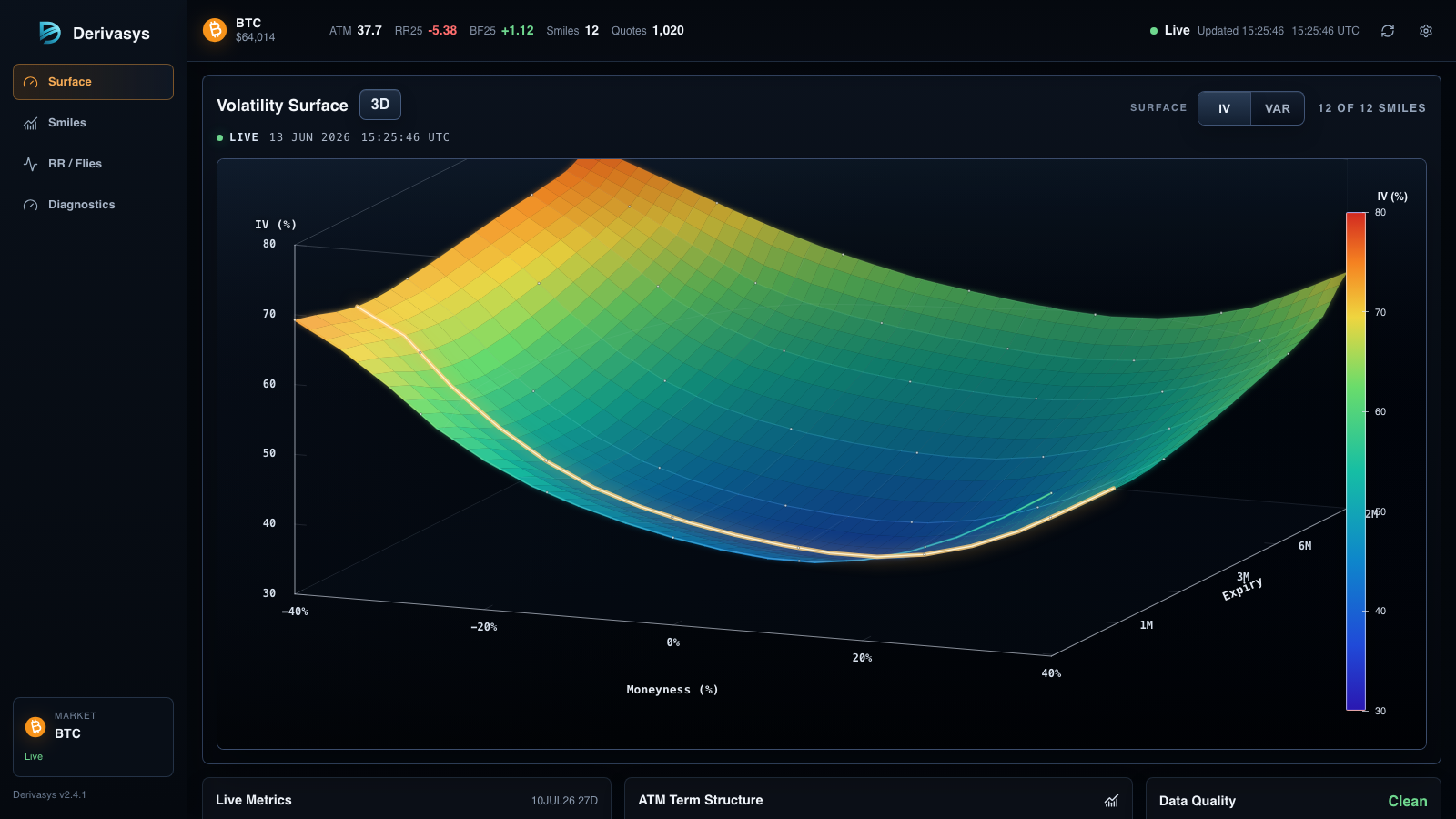


Show the source expiries
A dashboard should expose the two total-variance points used for each forward bucket, not only the final annualized number.
Keep fit diagnostics nearby
Forward volatility inherits every issue from the expiry smiles beneath it, so quote-through-fit checks need to sit close to term-structure charts.
Compare skew and curvature
A front-end event can change ATM forward volatility, downside skew, and fly curvature differently. Reviewing them together avoids false precision.
Flag held-back buckets
If an input smile fails guardrails, the derived forward bucket should be marked as held back rather than published as clean market state.
Topical path
Move from IV into the surface and dashboard workflow.
- Implied volatility: Start with the option-price-to-IV conversion.
- Volatility surface: Place forward volatility inside the full strike and tenor surface.
- SVI: Fit each expiry smile before comparing tenor buckets.
- Volatility smile: Inspect the one-expiry smile that feeds each total-variance point.
- Variance swaps: Use the same total-variance logic in realized-versus-implied variance payoffs.
- SSVI: Check whether the full tenor parameterization explains repeated forward-bucket breaks.
- SABR: Compare dynamic smile assumptions with direct total-variance surface construction.
- Local volatility: Connect arbitrage-aware surfaces to spot-and-time dynamics.
- Risk reversals: Inspect whether event premium lives in skew rather than only ATM term structure.
- Volatility flies: Track curvature changes when a forward bucket moves.
- Option Greeks: Translate forward-bucket moves into risk reports and sensitivity changes.
- Sticky strike vs sticky delta: Understand how forward moves change strike and delta-based interpretations.
- Technical articles: Read the engineering notes behind the live surface pipeline.
- Dashboard: Monitor live term structure and surface diagnostics.
FAQ
Common questions about forward volatility.
What is forward volatility?
Forward volatility is the volatility implied for a future time interval between two expiries. It is usually derived from the difference between total variance at the later expiry and total variance at the earlier expiry.
What is the forward volatility formula?
For expiries T1 and T2, forward variance equals (T2 times sigma2 squared minus T1 times sigma1 squared) divided by (T2 minus T1). Forward volatility is the square root of that forward variance.
How is forward volatility different from implied volatility?
Implied volatility is attached to one option expiry. Forward volatility isolates the volatility implied between two expiries, using the term structure of total variance.
Why does forward volatility matter for crypto options?
Crypto term structures can move around event windows and liquidity gaps. Forward volatility helps show whether one future bucket is rich, cheap, or inconsistent with neighboring expiries.
What does negative forward variance mean?
Negative forward variance means the later expiry has less total implied variance than the earlier expiry after scaling by time. In production this should trigger checks on forwards, quote quality, smile fits, and term-structure consistency.
Is forward volatility the same as a variance swap?
No. Forward volatility derives an implied future volatility bucket from option expiries. A variance swap is a contract comparing realized variance with a fixed variance strike, but both use total-variance arithmetic.
Why can forward volatility become negative?
Forward volatility becomes invalid when later-expiry total variance is below earlier-expiry total variance for the same coordinate. In production this should be treated as a calendar-arbitrage or data-quality holdback.
Should forward volatility be calculated from ATM IV only?
ATM forward volatility is the common starting point, but wings and fixed-delta buckets can imply different future variance. A surface dashboard should compare ATM buckets with risk reversals, flies, and SVI residuals.
How should a forward volatility API label the source data?
A forward volatility API should include the front expiry, back expiry, coordinate type, total-variance inputs, source surface versions, status, and any holdback reason.
References
Related Derivasys guides.
- Derivasys implied volatility guide
- Derivasys volatility surface guide
- Derivasys SVI guide
- Derivasys volatility smile guide
- Derivasys variance swaps guide
- Derivasys SSVI guide
- Derivasys SABR guide
- Derivasys local volatility guide
- Sticky strike vs sticky delta
- Derivasys risk reversal guide
- Derivasys volatility fly guide
- Derivasys option Greeks guide
- Derivasys technical articles